What commercial cleaning contracts cost in Columbia
By Kai Ellis · Updated 2026-06-12

Commercial cleaning pricing looks nothing like a residential quote, mostly because the buyer is not the person walking through the space every day. A facilities manager or business owner is comparing bids on square footage, frequency, and scope, often without ever watching a crew work. This directory’s home page is a reasonable starting point for browsing companies that serve business clients in the Columbia area.
How the base rate is built
Square footage and visit frequency are the two biggest levers. A 3,000 square foot office cleaned five nights a week costs substantially more per month than the same space cleaned twice a week, even though the per-visit rate for each cleaning might look similar on paper. Businesses with heavy foot traffic, like retail storefronts or medical offices, often need more frequent service than a quiet back office, which pushes the monthly total up regardless of square footage.
| Contract factor | How it moves the price |
|---|---|
| Square footage | Larger space, more line items per visit, higher base rate |
| Visits per week | More visits, higher monthly total, often lower per-visit rate |
| Type of space | Medical, food service, and retail typically cost more than general office due to sanitation standards |
| Add-on services | Carpet care, window washing, floor stripping billed separately from the base contract |
Commercial vs residential: not the same decision
A business deciding between a residential-style cleaner and a dedicated commercial contract is really deciding between two different service models, not just two prices. Commercial contracts are built around a documented scope of work and business-grade insurance; a residential cleaner’s pricing and paperwork rarely account for either.
Commercial contracts typically bundle liability coverage and a documented scope of work into the agreement itself, since a business has more at stake if a night crew damages equipment or a client-facing space is left in bad shape before opening. Residential cleaning, by contrast, is usually priced and scheduled far more loosely; see what house cleaning costs in Columbia for how that side of the market is quoted.
What pushes a quote higher than expected
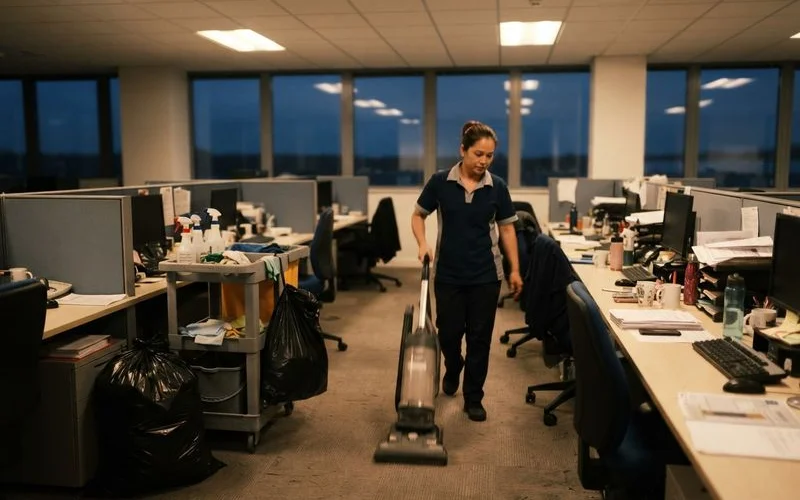
Specialized spaces cost more. A medical office or restaurant kitchen has sanitation requirements beyond wiping counters, which means more time, sometimes specific certifications, and often insurance minimums a general residential cleaner would not carry. After-hours or weekend service, which most offices prefer so cleaning does not disrupt the workday, also typically carries a premium over daytime scheduling.
Contract length matters too. A month-to-month arrangement generally costs more per visit than a company willing to sign a six or twelve month agreement, since the longer commitment lets the cleaning company plan staffing and routes further in advance.
Questions worth asking before signing
Ask for the scope of work in writing, itemized by task and frequency, not just a monthly total. A contract that only says “nightly cleaning” leaves too much room for disagreement later about what counts as included. Ask whether the same crew will be assigned consistently or whether staffing rotates, since consistency is one of the most commonly cited reasons businesses stay with or leave a commercial cleaning provider.
Confirm insurance and bonding explicitly rather than assuming it is standard. Businesses in the commercial cleaning category vary in what they carry, and a written confirmation protects you if equipment goes missing or damage occurs during an unsupervised after-hours visit.
Finally, ask how price changes are handled over the contract term. Cleaning supply costs and labor rates shift, and a contract that is silent on renewal pricing can mean an unpleasant surprise at the twelve-month mark.
Comparing bids without just chasing the lowest number
When bids come back with a noticeable spread, the temptation is to book the cheapest one, but that number usually means less service somewhere, fewer visits per week, a narrower scope, or lower-grade supplies. It is worth asking each bidder to itemize their scope the same way, so you are comparing genuinely equivalent packages rather than a bare-bones quote against a fuller one. A slightly higher bid with a clearly documented scope and confirmed insurance is often the safer long-term choice for a business, since the cost of a service failure, a client walking into a poorly cleaned lobby, tends to outweigh the savings from the cheapest contract. For the standards used to evaluate the companies in this directory, see how we rank.
FAQ
- How is commercial cleaning usually priced?
- Most contracts are priced per square foot per cleaning, then multiplied by how many visits per week or month you need. A small office cleaned twice a week costs less overall than the same office cleaned nightly, even though the per-visit rate might be similar.
- Is a monthly contract cheaper than paying per visit?
- Generally, yes. Standing contracts let a company schedule the same crew on a predictable route, which lowers their overhead and is usually reflected in a lower effective rate than booking one-off visits.
- What is included in a standard office cleaning contract?
- Trash removal, restroom sanitizing, vacuuming or mopping common areas, and surface dusting are typically standard. Carpet extraction, window washing, and floor stripping and waxing are usually billed as add-ons on a separate schedule.
- Should a commercial cleaning contract include insurance details?
- Yes. A written contract should specify liability coverage and whether the crew is bonded, since a business is exposed to more risk than a homeowner if something is damaged or goes missing during an after-hours visit.